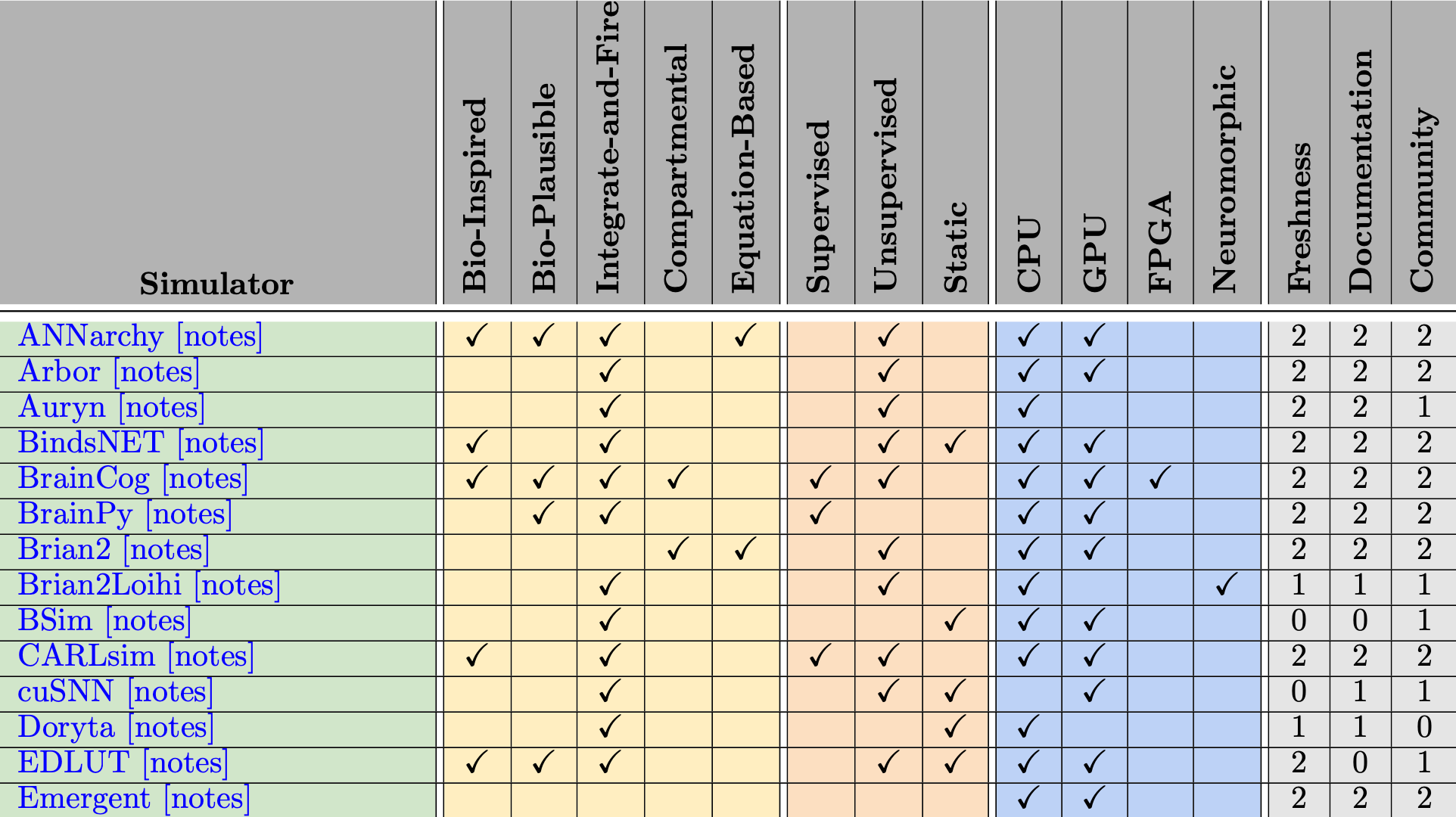
Screenshot of portion of software simulator survey worksheet

Software Simulator Survey

As I was starting my journey in Neuromorphic Computing, I wanted to get a better understanding of the landscape of software simulators for spiking neural networks. It was difficult for me as a newcomer as I was reading various papers to understand which simulators were open source and publicly available and those that were not. Some were software frameworks or libraries that only supported hardware simulators and others simply provided tools to extend the capabilities of existing software simulators, but did not provide the simulator itself. Some simulators are released open source, but have not been maintained since that initial release while others provide extensive documentation and regular updates.

What began as a simple literature review in September 2024 quickly turned into a months-long project to identify the current state of open-source software simulators for spiking neural networks, cataloging supported neuron models, learning mechanisms, and supported hardware platforms. It also builds upon my previous work with software engineering research and the open-source CHAOSS project to develop a viability scorecard that I use to examine the code freshness, documentation, and community engagement of each simulator. A preprint of the paper, Finding Order in CHAOSS: A Survey of Open-Source Spiking Neural Network Software Simulators, is available on arXiv. However, we have extensive notes and a simulator selection worksheet that did not make it into the paper that I am sharing here for others to use and build upon in their own research journeys.
Worksheet (PDF) Worksheet (HTML) arXiv (pending)
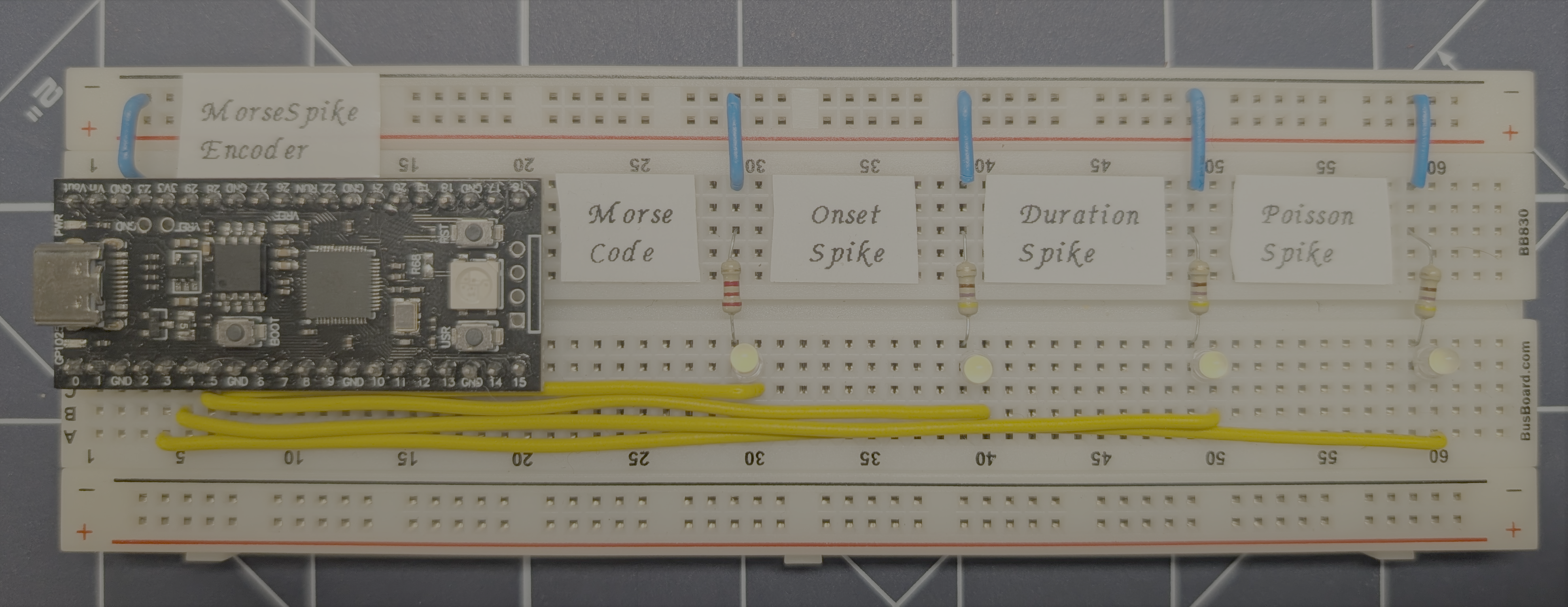
Breadboard implementation of spike encoder

Morse Spike Encoder

This project started as a way to explore purely temporal encoding schemes for spiking neural networks, using Morse code as a test case. I am an extra class amateur radio operator, call-sign KE7BKK, and have been fascinated by Morse code for years. It seemed like a natural fit to use it as a way to explore temporal encoding in SNNs, since Morse code is all about timing and patterns of short and long signals. Concurrently, I have been interested in exploring the capabilities of the RP2040 micro-controller, particularly the PIO state machines and multithreading capabilities. This project has been a fun way to combine those interests and see how well the RP2040 can handle real-time spike encoding tasks.

The Morse Spike Encoder allows the user to connect via a serial console, set a text message, and then either send it as a one-shot or loop it continuously. It utilizes a producer/consumer model where the producer thread (morse_encoder) handles the timing and generation of morse code elements (dot/dash). The Consumer threads (poisson_encoder,temporal_duration_encoder, and temporal_onset_encoder) wait for the symbol, encode it into an appropriate spike pattern, and the utilize PIO state machines to generate the actual spike train output. Protothreads are used for lightweight concurrency, allowing the producer and consumer threads to run independently while sharing data through a simple synchronization mechanism. The project demonstrates how temporal patterns can be effectively encoded into spike trains, and serves as a testbed for exploring different encoding strategies in spiking neural networks.

GitHub